
Symphony Wave Power is a new and innovative system for generating wave energy. With the Symphony, energy from waves is directly converted into electricity. The basis for the design is simple and the number of parts is limited. The Symphony is also recyclable, animal-friendly and requires little maintenance. Close to the coast, a field of 20 Symphonys, with an installed capacity of 100 kW per buoy, can supply sufficient electricity for, for example, all households on a Wadden island such as Texel. Further from the coast, the waves have more energy and the Symphony can supply even more electricity, making the generated energy suitable for the production of hydrogen.
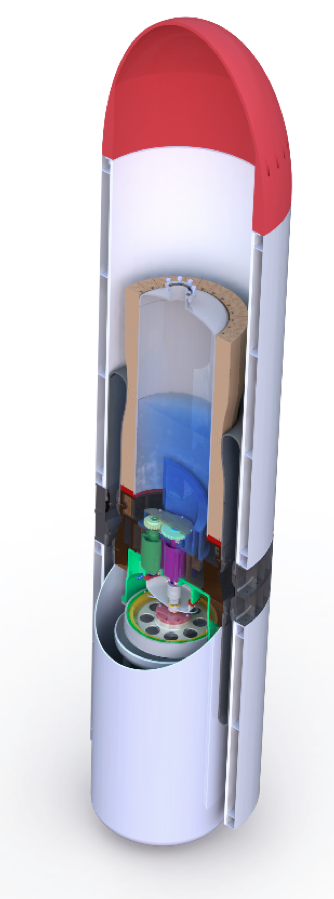
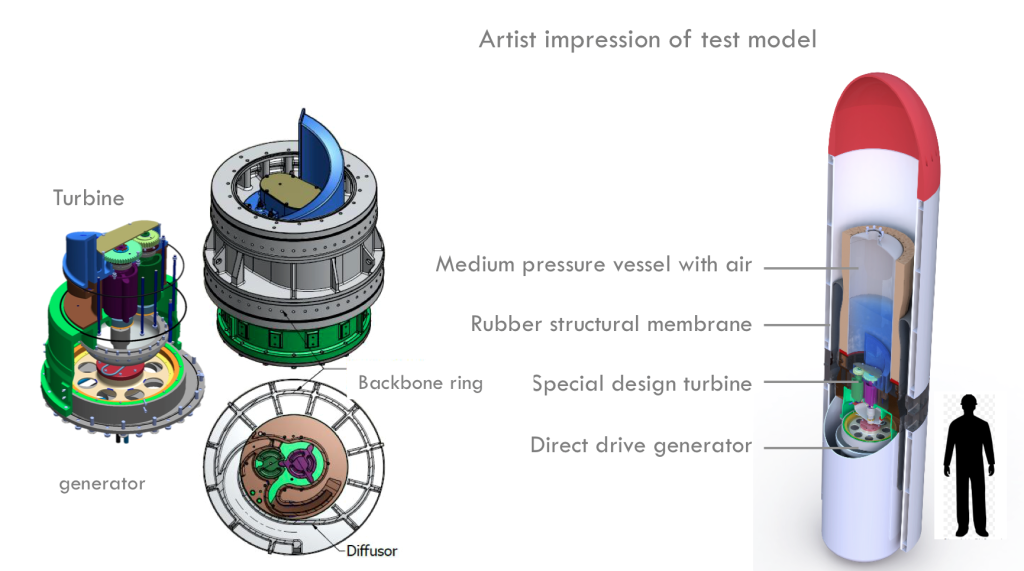
The working of Symphony can be explained shortly as a device with an internal spring that resonates at the wave frequency. Already small waves will attenuate the Symphony motion up to the full stroke. The generator damps this motion by extracting electrical energy.
The system is placed ca. 6 meter under the neutral waterlevel, it will experience a pressure field under the wave crest. This will push the outside hull down and comperes the air inside. Under a wave trough the air will expand and push the outside up a gain.

If the natural frequency of the system is close to the wave frequency, it will be able to abstract energy from a larger area. Tis is called point absorption in wave energy literature. This phenomenon has been studied extensively, but not many devices have been able to apply it. Because it is potential destructive. As the device charges itself with energy it will hit the mechanical endstops and destroy itself. In this device the endstops are integrated in the shape in which the membrane rolls. This gives the endstop the characteristic of a stiff spring. A buffer, that not dissipates the energy, but gives it back. By doing so it causes a small delay which lowers the intake of energy. A fully passive control of the kind you need to follow the KISS principles. Below graphs that came from the design study performed by a student of the Technical university of Twente is given.
 Nederlands
  English (UK)